
Web Development Austin, SEO Austin, Austin Search Engine Marketing, Internet Marketing Austin, Web Design Austin, Roundrock Web Design, IT Support Central Texas, Social Media Central Texas

Month: January 2022

The Need For Automated Security Awareness Training

Cybercriminals are skilled at exploiting how firms conduct their daily business operations. While the Covid19 pandemic was at its peak of causing havoc across the world, cyberattacks witnessed a 500 percent surge. As human factor is the weakest link in the entire cybersecurity domain, it is important to conduct Automated Security Awareness trainings to make employees aware of methods on how to safeguard assets from such attacks.

How to plan an automated security awareness campaign?

Fraudsters are excellent strategists, and they build phishing campaigns that are focused on a certain attack approach to increase their success rates. A security awareness campaign should also be planned to be automated over a 12-month period. This strategy should correspond to your employee’s role in planning, managing, and delivering the most relevant parts to the correct audience at the right time. Computerized and automated security awareness training must include the following aspects:

  1. Blogs for upskilling and reskilling
  2. Phishing emails that aren’t real to check employees’ alertness
  3. Online learning that is customized as per business requirements
  4. Surveys and skill-check quizzes to evaluate employees’ security awareness
  5. Risk evaluations and assessments for disaster resiliency of systems and networks
  6. Crucial Security and GRC (Governance, Risk management, and Compliance) Policies

Each of these factors contributes to employees’ gradual awareness of how security approaches and tactics function, as well as how security incidents can occur.

How the leadership will be able to determine the success of such training?

Simulated phishing that is automated and integrated with metrics and feedback cycles is important for training your personnel about phishing and social engineering techniques. These simulations teach your employees how to spot common fraudster tactics. This includes techniques such as BEC (Business Email Compromise), infection through malicious attachments, malicious URLs, spoof sites, and so on. vendor updates the templates used to replicate phishing campaigns on a regular basis to reflect any changes in the phishing landscape. An automated security awareness training provides a vital audit trail of immutable metrics & feedback. Data from the metrics and audit of awareness training across many touchpoints can be sent back into the awareness training to help it improve. These audit trails also aid regulatory defense in the case of a breach or during a compliance examination. Employee reactions to the mock phishing communication are automatically captured as part of the phishing simulation exercise. This generates measurements that reflect how well the training is going and allows the phishing templates to be tailored to improve overall phishing education.

Advantages of automated security awareness training campaigns

All stakeholders in the delivery, management, and end-user experience of cybersecurity awareness training benefit from the automation in the following ways:

  1. Increasing the organization’s resilience to cyberthreats
  2. Assisting in establishing a security-conscious work culture
  3. Procure buy-in and support for cyber security measures
  4. Improving the audit results and showing regulatory compliance
  5. Reducing human error and addressing security concerns
  6. Reducing the time and resources needed to organize an awareness campaign by creating a 12-month calendar of activities, identifying areas of overlap, and identifying user fatigue
  7. Control policies, phishing simulators, eLearning, and surveys from a central location

Automated security awareness training solutions actually do quite more than just impart knowledge; it also develops tangible cyber-hygiene skills and habits in employee staff. Such solutions and services help your company at every stage of improving your corporate security awareness journey. Leadership can envision the entire journey right from goal-setting to results-evaluation through actionable reporting and analytics. Simplified goal-setting, automated learning paths, and practical activities based on real-life circumstances all help participants and training managers achieve effective results and a successful outcome.

Centex Technologies provide state of the art cyber-security and IT systems for enterprises. To discuss requirements for your organization, you may contact at (254) 213 – 4740.
Cyber Identity Theft: What To Do?

Identity theft is one of the most common and fast growing cyber-crimes. Cyber identity theft occurs when a fraudster steals a user’s identity or say poses to be that user by gaining access to his Personally Identifiable Information (PII). To get details of user’s digital PII fraudsters use scams like phishing attacks or planting a malware on the victim’s system.

What is his Personally Identifiable Information (PII)?

It is the unique personal information that enables a fraudster to prove his identity as the victim. Some examples of PII include:

  • Driver’s License
  • Banking Information such as account number
  • Login Id & Password for various online accounts
  • Social Security Number

In order to understand what happens if cyber identity is stolen, it is first important to know how online identity theft occurs. Some of the tactics used by fraudsters are:

  • Phishing: Cybercriminals send emails with compromised links that are disguised as essential information from a financial institution. The link, when clicked, opens a form that requires the user to provide his PII.
  • Pharming: Under this tactic, the browser is compromised. The user enters a legitimate address in the search bar of the browser, but is redirected to a malicious page designed to steal PII.
  • Malware: Specially designed malware can be downloaded on victim’s system via different sources to steal financial details.
  • Unsecure Websites: Make it a point to check the authenticity of the website before making an online purchase. Make sure to use official and secure websites with “https” prefix.
  • Weak Passwords: Using weak passwords for social and financial accounts leaves users vulnerable and susceptible to hackers.

Once the online identity is stolen, it can give rise to an array of problems for the victim:

  • Fraudsters can use the victim’s credentials to infiltrate an organization’s network and gain access to business secrets.
  • The PII can be used to gain access to victim’s financial accounts and exploit them.
  • The stolen identities can be sold by the fraudsters over dark web.
  • Victim’s identity can be used to enter the system and encrypt the data for ransom.
  • Stolen PII can be used to cause non-monetary damage such as hampering the public image.

In case you discover that you have been victimized by an identity breach, take following measures:

  • Regularly monitor your bank statements and credit reports for any unauthorized activity.
  • In case of an unusual activity, follow up immediately and consider putting your credit report on hold.
  • Consider using activity alerts services offered by financial institutions

For more information on cyber identity theft and methods to prevent them, contact Centex Technologies at (254) 213 – 4740.


Need Of IT Infrastructure Management For Fintech Businesses

FinTech companies need to manage their IT infrastructure to ensure their daily activities and operations continue running efficiently. FinTech or Financial Technology firms heavily depend on complex IT and cybersecurity systems to manage their businesses. Over time, these systems undergo deterioration and become vulnerable to security attacks. As a result, FinTechs require upkeep and maintenance of such business-critical systems.

FinTech and BFSI (Banking, Financial Services, and Insurance sector) companies are encouraged to enhance their IT infrastructure for:

Reducing IT Security Risks – Planning, setting scope, and mitigating cyber threats are a part of a comprehensive IT InfraSec management program. High severity incidents, attacks, and data leaks are less frequent and have minimal impact when threat and vulnerability management is implemented. The first step in reducing the IT security risks is to determine the features essential to protect infrastructure. The next step is to set up monitoring and visibility infrastructure that ensures the ongoing scans of all systems. Identification of internal and external infrastructure vulnerabilities and threats is very important. Any MSSP (Managed Security Service Providers) could be called in to provide their services so as to speed up the deployment of security across the FinTech company. MSSPs (Managed Security Service Providers) help in performing threat detection and incident response exercises and simulations. They also help in hunting threats across the organizational systems and network. Cybersecurity professionals from MSSPs perform root cause analysis to each and every incident that occurred within the infrastructure. Complying with government regulations and standards is also crucial to running FinTech businesses. MSSPs ease your journey to getting compliance certified.

Continuity of Operations – Even the most powerful cybersecurity frameworks can’t guarantee that there will be no incidents, leaks, or other cyber-attacks. A fintech company with good IT infrastructure management doesn’t have to shut down if sensitive data is lost or corrupted. Instead, the backups and data recovery plans are most likely in place. Infrastructure management also provides FintTech companies with effective incident management policies that include:

  1. Identification of the occurrence of malicious activity
  2. The relevant alerts logged and documented
  3. Analysis and investigation procedures implemented
  4. Adjustment and assignment of the tasks to professionals
  5. Remediation and resolution of alerts and incidents
  6. Customer Feedback is analyzed for continuous improvement

Implementation could be scaled-up and down – The deployment of substantial IT infrastructure, frequently on short notice, is one of the most difficult tasks that FinTechs face. This procedure can be made simple by good infrastructure management, that allows the company to scale up and down as needed. Infrastructure management encompasses assistance with architecture implementation at all stages of the process. This includes original planning, development and acquisition, lifecycle management, and secure system termination. A strong managed architecture implementation package should also interact seamlessly with any current risk and incident management infrastructure. To entirely protect the sensitive assets, architecture implementation should also involve extensive training and awareness services. This ensures that all stakeholders understand their duties and how to uphold them.

Well-organized regulatory compliance – Another reason for the FinTech industry is ensuring compliance with numerous legislations. The PCI-DSS applies to any BFSI organization that processes credit card transactions or cardholder data. PCI-DSS is the acronym for Payment Card Industry Data Security Standards. Many businesses may be forced to perform SOC audits due to governmental or industry pressure. This is to ensure that the AICPA’s (American Institute of Certified Public Accountants) SOC requirements are met. SOC stands for Security Operations Center. Fintechs working in or near the healthcare sector will almost certainly need to comply with HIPAA, either as covered firms or business associates. HIPAA stands for Health Insurance Portability and Accountability Act. These are just a handful of the compliance issues that companies in the FinTech industry might face. A regulatory compliance advice package should be included in every comprehensive infrastructure management program. That package must optimize and streamline compliance through assessment, mapping, and reporting.

For more information on IT infrastructure management for enterprises, contact Centex Technologies at Killeen (254) 213-4740, Dallas (972) 375-9654, Atlanta (404) 994-5074, and Austin (512) 956-5454


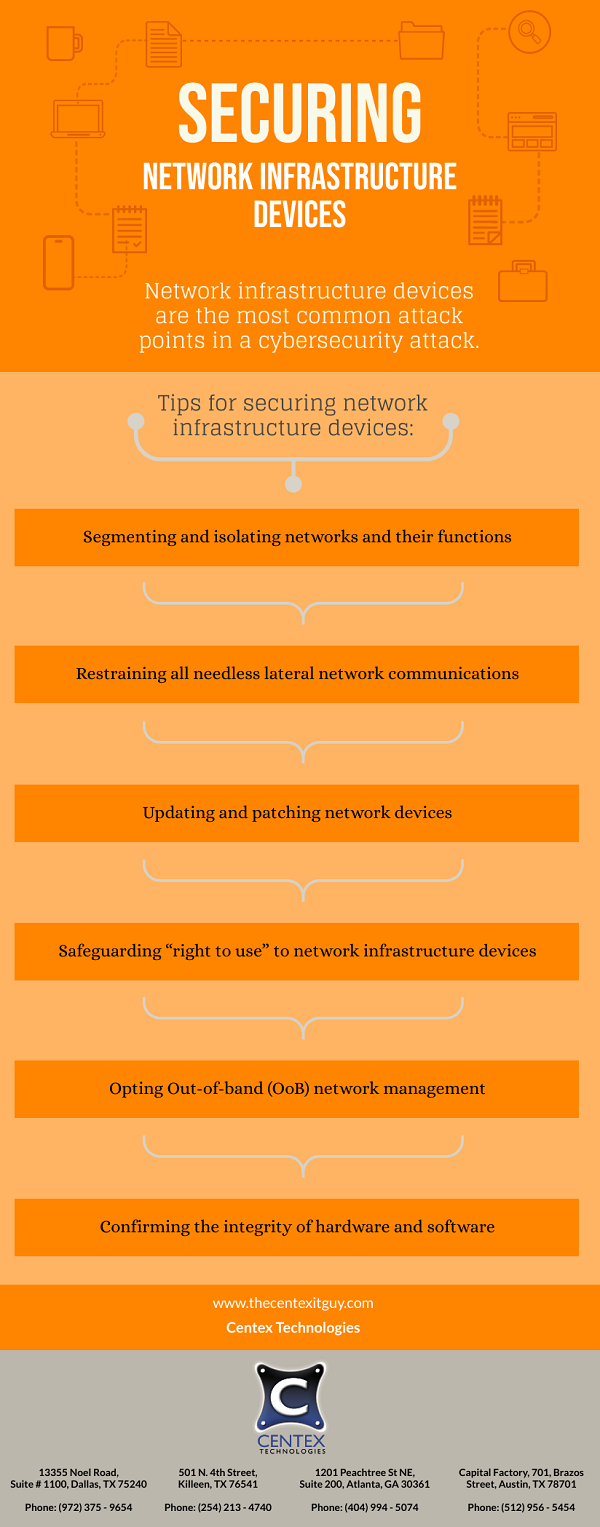
Securing Network Infrastructure Device

PDF Version: Securing-Network-Infrastructure-Device

© Copyright 2022 The Centex IT Guy. Developed by Centex Technologies
Entries (RSS) and Comments (RSS)